Get Your Free Quote…!

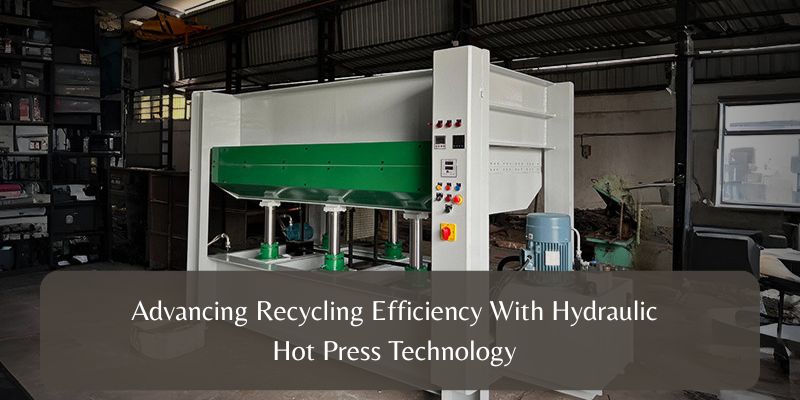
The increasing demand for sustainable industrial practices has placed recycling technologies at the forefront of modern manufacturing. Recycling plants are no longer limited to waste management alone. They are now responsible for converting discarded materials into valuable products that can re enter the production cycle. Hydraulic hot press machines support this transformation by applying controlled heat and pressure to compress waste materials into durable sheets and panels.
These systems help industries process plastic waste and multilayer packaging efficiently while maintaining high product quality and structural reliability.
Plastic waste recycling requires a series of carefully managed processes that convert discarded materials into usable forms. After sorting, shredding, and cleaning the plastic, the material must be compressed into solid sheets that can be reused in construction and industrial applications.
A Hydraulic Hot Press Corrugated Roof Sheet system enables manufacturers to process recycled plastic into strong sheets that can later be formed into corrugated profiles. The combination of hydraulic pressure and heat allows the plastic particles to melt and bond together evenly, creating dense panels with improved durability.
These features make recycled corrugated sheets suitable for roofing structures in warehouses, temporary buildings, and industrial sheds.
A Hot Press for Plastic Waste Recycling Plant plays a vital role in transforming shredded plastic into compact and uniform panels. During the pressing cycle, plastic particles soften under heat while hydraulic pressure compresses them into dense sheets.
This method improves bonding strength and ensures that the recycled product maintains consistent thickness and durability. The pressed sheets can be further processed into several products, including:
The ability to convert waste plastic into functional materials supports the development of circular manufacturing systems.
Recycling multilayer packaging such as tetra packs presents a significant challenge due to the presence of paper, plastic, and aluminum layers. Traditional separation methods can be expensive and time consuming.
A Hydraulic Hot Press Tetra pack Recycling Plant addresses this issue by compressing shredded packaging waste under controlled heat and pressure. During the pressing process, the plastic component melts and acts as a binding material that holds the layers together.
The compressed boards produced through this process are strong, moisture resistant, and suitable for various construction and furniture applications.
| Product Type | Typical Application |
|---|---|
| Partition boards | Interior construction panels |
| Furniture boards | Table tops and cabinets |
| Structural sheets | Temporary building materials |
| Decorative boards | Wall panels and surfaces |
This approach allows recycling facilities to reuse complex packaging waste without relying on additional chemical binders.
Consistency is essential in recycling operations. Variations in heat or pressure can result in sheets with uneven thickness or weak bonding. Advanced hot press machines help maintain stable processing conditions throughout each production cycle.
A Hot Press Machine for Plastic Waste Recycling Plant is equipped with hydraulic control systems and heating plates that ensure uniform pressure and temperature distribution. These machines typically include automated controls that allow operators to regulate pressing time, temperature, and load.
The result is reliable sheet quality across multiple production batches, which helps recycling plants meet industrial standards while minimizing material waste.
Hydraulic hot press machines used in recycling plants offer several advantages that improve both productivity and sustainability.
These capabilities allow recycling plants to operate more efficiently while producing high value materials from waste streams.
As industries move toward environmentally responsible production methods, recycling technologies play an increasingly important role. Hydraulic hot press systems allow manufacturers to convert plastic and packaging waste into durable materials that can be reused in construction and manufacturing applications.
Through advanced engineering and specialized press technology, companies such as Ambica Press help industries adopt efficient recycling solutions that transform waste into valuable resources while supporting long term sustainability goals.