Get Your Free Quote…!

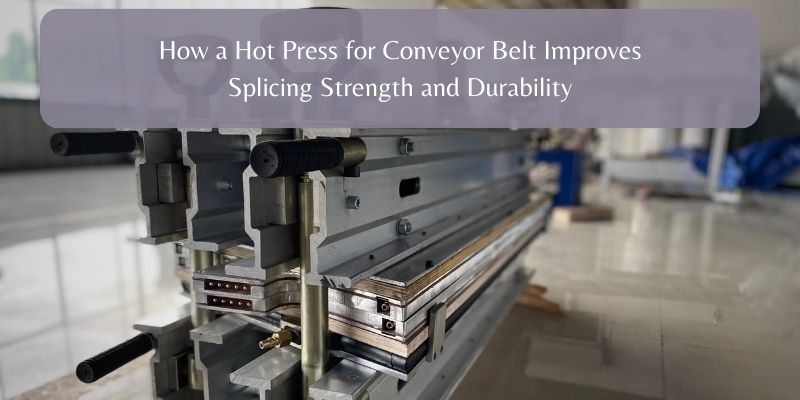
In material handling and industrial transport systems, belt performance directly affects productivity, safety, and operating costs. One of the most critical factors influencing long-term performance is splice quality. A weak joint often becomes the first point of failure, leading to downtime and repeated maintenance. This is where a Hot Press for Conveyor Belt plays a decisive role. By applying controlled heat and pressure during splicing, this equipment ensures joints that are structurally strong, dimensionally stable, and capable of withstanding demanding operating conditions.
Splicing connects belt ends into a continuous loop, allowing smooth and uninterrupted operation. Mechanical joints may offer speed of installation, but they often compromise strength and flexibility. Thermal bonding, achieved through hot pressing, creates a uniform joint that closely matches the belt’s original properties.
A properly executed splice distributes load evenly across the joint, reducing stress concentration. This balance is essential for systems operating under constant tension, heavy loads, or high-speed conditions.
The effectiveness of hot pressing lies in the precise combination of temperature, pressure, and time. Heat softens the bonding layer, while pressure ensures intimate contact between surfaces. As the materials cure, a cohesive bond forms that integrates the splice into the belt structure.
This process eliminates gaps and inconsistencies that can lead to premature wear. The result is a joint that behaves like a continuous section rather than a vulnerable connection point.
Manual splicing methods often rely on operator experience, leading to variation in joint quality. A hot press introduces consistency by maintaining stable parameters throughout the process. Temperature sensors, pressure controls, and uniform heating plates ensure repeatable outcomes.
Such consistency becomes particularly valuable in large-scale operations where multiple belts require identical performance characteristics. Use of a Hot Press Machine for Conveyor Belt supports standardisation across installations and maintenance cycles.
Industrial belts are exposed to abrasion, moisture, chemicals, and fluctuating temperatures. A thermally bonded splice offers superior resistance to these stresses compared to mechanical alternatives. The absence of metal fasteners also reduces the risk of corrosion or damage to pulleys and rollers.
Durable joints extend service intervals and lower the frequency of unplanned shutdowns, contributing to smoother operations and predictable maintenance planning.
One of the challenges in splicing is achieving flexibility alongside strength. Excessively rigid joints can cause tracking issues or uneven wear. Hot pressing allows the splice to retain flexibility similar to the parent belt, supporting smooth movement over rollers and drums.
This balance is critical in systems with smaller pulley diameters or complex routing, where joint adaptability directly influences performance.
Hot press technology is adaptable to various belt compositions, including fabric-reinforced, steel-cord, and specialty elastomers. The same principle applies to other industrial materials requiring controlled bonding.
For example, similar technology is used in applications involving Hot Press for High Temperature Silicone Rubber Sheet , where thermal stability and bond reliability are essential. This versatility highlights the broader industrial relevance of controlled hot pressing systems.
A strong splice minimises secondary issues such as belt misalignment, edge fraying, and uneven tension. These factors often contribute to accelerated wear and additional maintenance tasks.
By improving joint reliability, hot pressing reduces the total cost of ownership. Fewer repairs, longer belt life, and stable operation translate into measurable operational savings over time.
Splice failure poses safety risks, especially in heavy-duty conveying systems. Sudden belt separation can damage equipment and endanger personnel. Thermally bonded joints significantly lower this risk by providing predictable strength characteristics.
Reliable splicing supports compliance with safety standards and reduces the likelihood of emergency interventions during operation.
Modern hot press systems are designed for both workshop-based fabrication and on-site maintenance. Portable configurations allow splicing directly at installation locations, reducing downtime associated with belt removal and transport.
This flexibility supports rapid response maintenance strategies without compromising joint quality.
Hot pressing aligns well with preventive maintenance philosophies. By ensuring high-quality splices from the outset, maintenance teams can focus on monitoring wear patterns and scheduling interventions proactively rather than reacting to failures.
This approach improves operational predictability and extends the effective lifespan of conveying systems.
Splicing quality remains a decisive factor in belt performance and longevity. Controlled hot pressing transforms the joint into a durable, flexible, and reliable section of the system rather than a potential failure point. Selecting the right Hot Press for Endless Rubber applications ensures that splices meet the demands of modern industrial operations. Within this context, Ambica Hydraulics Ambica Hydraulics reflects the importance of precision-engineered solutions in supporting long-term strength, durability, and efficiency across conveying systems.