Get Your Free Quote…!


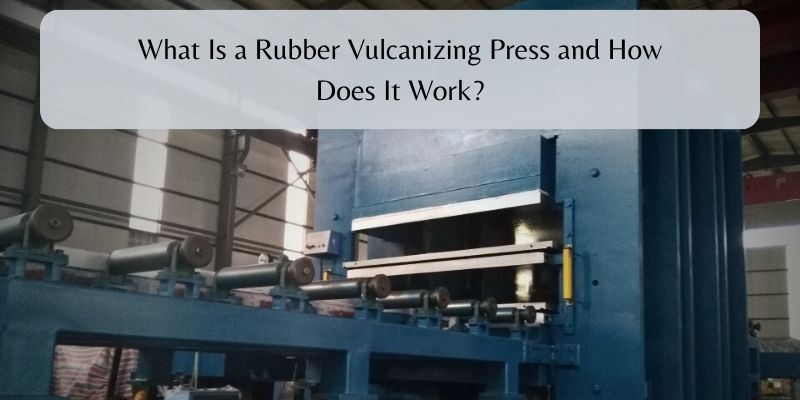
Modern manufacturing relies on processes that transform raw materials into durable, high-performance components. In rubber processing, few machines are as critical as the rubber vulcanizing press. This equipment enables rubber compounds to achieve strength, elasticity, and long-term stability, making them suitable for demanding applications across multiple industries. Rather than being a simple compression tool, the press represents a controlled environment where heat, pressure, and timing converge to alter material structure at a molecular level.
Understanding how this system functions offers insight into why it remains central to industrial production lines that value consistency and reliability.
Raw rubber, in its untreated state, lacks the resilience required for practical use. It can deform easily under heat and becomes brittle in colder conditions.
Vulcanization addresses these limitations by applying controlled heat and pressure to rubber compounds, triggering chemical cross-linking within the material. This transformation improves tensile strength, elasticity, and resistance to wear, enabling rubber products to perform reliably in real-world conditions.
A rubber vulcanizing press typically consists of a sturdy frame, heated platens, and a pressure application mechanism. Each component plays a specific role in ensuring uniform results.
The platens provide even heat distribution, while the pressure system ensures consistent contact between the mould and the rubber compound. Together, these elements create the precise conditions needed for effective curing.
The process begins by placing uncured rubber into a mould positioned between heated platens. Once aligned, the press closes, applying a predetermined level of pressure.
Heat activates the vulcanization reaction, while pressure ensures the compound fills the mould cavity evenly. After a set curing period, the press opens, releasing a finished component with enhanced physical properties.
Temperature, pressure, and time are carefully calibrated during operation. Small variations can affect product quality, making control systems an essential feature.
Modern presses are designed to maintain stable parameters throughout the cycle, ensuring repeatable outcomes across production batches.
Rubber vulcanizing presses serve a wide range of industries, including automotive, construction, electrical insulation, and consumer goods.
In automotive manufacturing, specialised systems such as Hydraulic Hot Press Automobile Industries Die Punch Press configurations support the production of seals, gaskets, and vibration-dampening components. These applications demand precision and durability, which vulcanization provides.
Presses can be configured for compression, transfer, or injection moulding, depending on production requirements. This adaptability allows manufacturers to process diverse rubber formulations and component designs.
Interchangeable moulds and adjustable settings further enhance versatility, enabling efficient transitions between product lines.
Uniform heat distribution is critical during vulcanization. Uneven heating can lead to incomplete curing or internal stress within the product.
Press designs prioritise platen alignment and temperature consistency to ensure each section of the moulded component receives equal treatment.
While primarily associated with rubber, vulcanizing press technology shares similarities with other industrial pressing systems.
For example, processes used in Hot Press Machine for Plywood applications also rely on controlled heat and pressure to bond materials. This shared principle highlights the broader relevance of press-based manufacturing across sectors.
Given the high forces involved, presses are engineered with robust frames and reinforced components. Structural integrity ensures long-term performance and operational safety.
This durability supports continuous use in demanding production environments without compromising accuracy.
Safety mechanisms are integral to press design. Interlocks, pressure relief systems, and temperature monitoring protect operators and equipment alike.
Reliable operation not only safeguards personnel but also preserves product consistency by preventing unexpected interruptions.
Routine maintenance ensures continued accuracy and efficiency. Regular inspection of heating elements, pressure systems, and alignment helps prevent downtime.
As industries demand higher output without sacrificing quality, rubber vulcanizing presses provide a balance of speed and precision.
Their ability to deliver repeatable results makes them a cornerstone of efficient production planning.
A rubber vulcanizing press plays a vital role in transforming raw compounds into reliable, high-performance products used across modern industries. By combining heat, pressure, and precision control, it delivers consistent outcomes that meet demanding technical standards. As manufacturing continues to evolve, solutions such as Hot Press for Film face Compare High Densified processes reflect the broader relevance of advanced press technology—an approach aligned with the engineering focus of Ambica Hydraulics Pvt. Ltd.