Get Your Free Quote…!

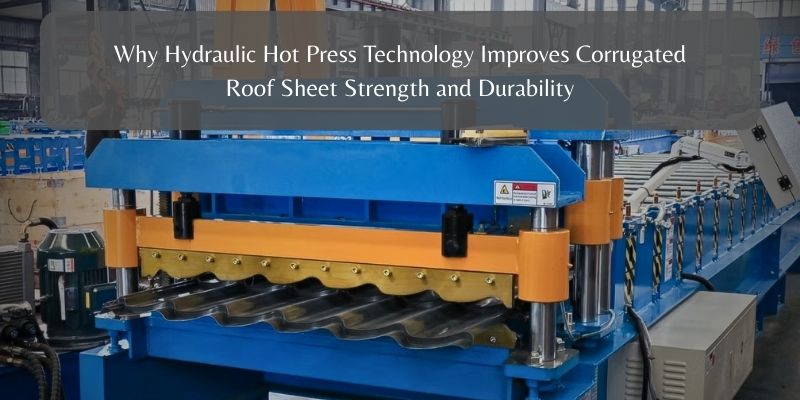
Infrastructure development increasingly demands roofing materials that combine structural integrity, weather resistance, and long service life. Corrugated roof sheets are widely used in industrial sheds, warehouses, agricultural facilities, and low-cost housing projects due to their lightweight nature and cost efficiency. However, the true strength and durability of these sheets depend significantly on the manufacturing process. Advanced systems such as the Hydraulic Hot Press Corrugated Roof Sheet technology have redefined production standards, delivering enhanced density, bonding strength, and uniformity across panels.
By applying controlled pressure and temperature simultaneously, this technology ensures optimal consolidation of composite layers. The result is improved structural cohesion and reduced internal voids, both of which directly influence load-bearing capacity and resistance to environmental stress.
Corrugated roofing panels often incorporate composite materials derived from recycled or blended substrates. Without precise compression and thermal treatment, these layers may fail to bond effectively.
Simultaneous application of force and heat ensures that materials fuse into a cohesive and stable structure.
Structural strength is essential for roofing applications exposed to wind loads, heavy rainfall, and occasional impact. Advanced pressing systems increase material compactness, resulting in stronger panels.
These qualities make corrugated sheets suitable for demanding environments.
Roofing materials must withstand temperature fluctuations, moisture exposure, and ultraviolet radiation. Controlled pressing enhances surface compactness, limiting moisture penetration and structural degradation.
Such resilience supports extended service life.
Sustainable construction increasingly relies on recycled composite materials. Press-based systems play a crucial role in converting waste-derived materials into durable roofing solutions.
Technologies similar to those used in a Hydraulic Hot Press Tetra pack Recycling Plant demonstrate how layered waste materials can be transformed into high-strength boards and panels through controlled compression and thermal bonding.
This approach supports circular economy principles.
Uniform thickness ensures predictable performance during installation and use. Variations can compromise alignment and structural stability.
Consistency simplifies installation and enhances aesthetic uniformity.
Modern pressing systems are designed to optimise energy usage while maintaining performance standards. Automated controls regulate pressure cycles and temperature levels with precision.
Efficient production enhances cost-effectiveness without sacrificing quality.
Corrugated roof sheets may incorporate composite blends derived from recycled packaging, fibre reinforcements, or polymer-based materials. Advanced pressing systems accommodate diverse formulations.
Solutions comparable to a Hot Press for Plastic Waste Recycling Plant illustrate how waste-based polymers can be compressed into durable structural sheets suitable for construction use.
Such adaptability supports innovation in sustainable roofing.
Panels manufactured through controlled pressing exhibit improved resistance to cracking, delamination, and surface degradation. This durability reduces maintenance frequency and replacement costs.
Durable roofing solutions contribute to long-term cost savings.
Construction sectors worldwide increasingly prioritise eco-friendly solutions. Press-based technology enables manufacturers to integrate recycled content while maintaining performance standards.
Such practices align with modern green building initiatives.
Controlled pressure and thermal technology significantly enhance the strength, durability, and consistency of corrugated roofing panels. By improving bonding, density, and weather resistance, advanced pressing systems elevate product performance while supporting sustainable material integration. From recycling composite packaging to processing polymer-based blends, this technology ensures reliable structural output.
For industries seeking dependable expertise in advanced pressing systems such as the Hot Press Machine for Plastic Waste Recycling Plant, Ambica Hydraulics delivers engineered solutions designed to meet evolving construction and sustainability standards. Precision-driven manufacturing continues to strengthen the future of durable roofing solutions.